

How It Works
Step : 1

Sign Up
Register your observatory and telescope details
Step : 2

Download & Install App
Use our guide to install and configure the app
Step : 3

Upload Frames
Lemur auto-detects and queues your data
Step : 4

Automatic Processing
Astrometry, photometry, cross-matching all done in one pass
Step : 5

Review Results
Visualize, download reports, or export data
How to use the Lemur software
We have prepared a set of test series (asteroid and artificial satellite), on which you can compare the raw and processed by the Lemur software series of frames (see Demo Series).
Short how to use the Lemur service for processing and review results:
- download and read the documentation
- download the Lemur client – by downloading you agree with the Lemur License Agreement
- install the Lemur client:
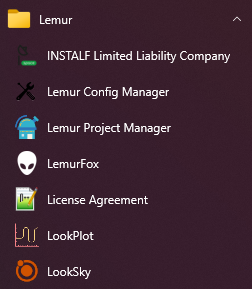
For Windows: unpack -> run the lemur installer “lemur_x.x.x.x_win64.exe” and follow the instructions -> Lemur client shortcuts in the Windows Start menu:
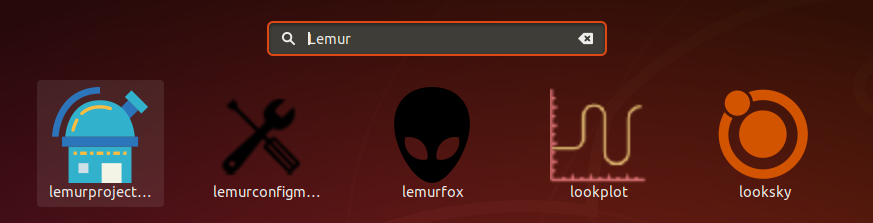
For Linux: use the following command in the console terminal “sudo apt install ./lemur_x.x.x.x_amd64.deb” -> Lemur client shortcuts in the Ubuntu Activities menu:
Download the Demo Series of frames
Launch the Lemur Project Manager:
- Fill in demo server address (“lemur.instalf.pl“) and your e-mail and password to register in the system
- Create new project and add downloaded raw demo series of frames
- Start processing
Wait for the completing of processing and download the processing results
Launch the frame viewer LookSky:
- Open processing results
- Review the detected objects and tracks
- Create the appropriate reports and animation of the detected objects
Send us the feedback [email protected] it is important for us
APP & Documentation
Demo Series
Description:
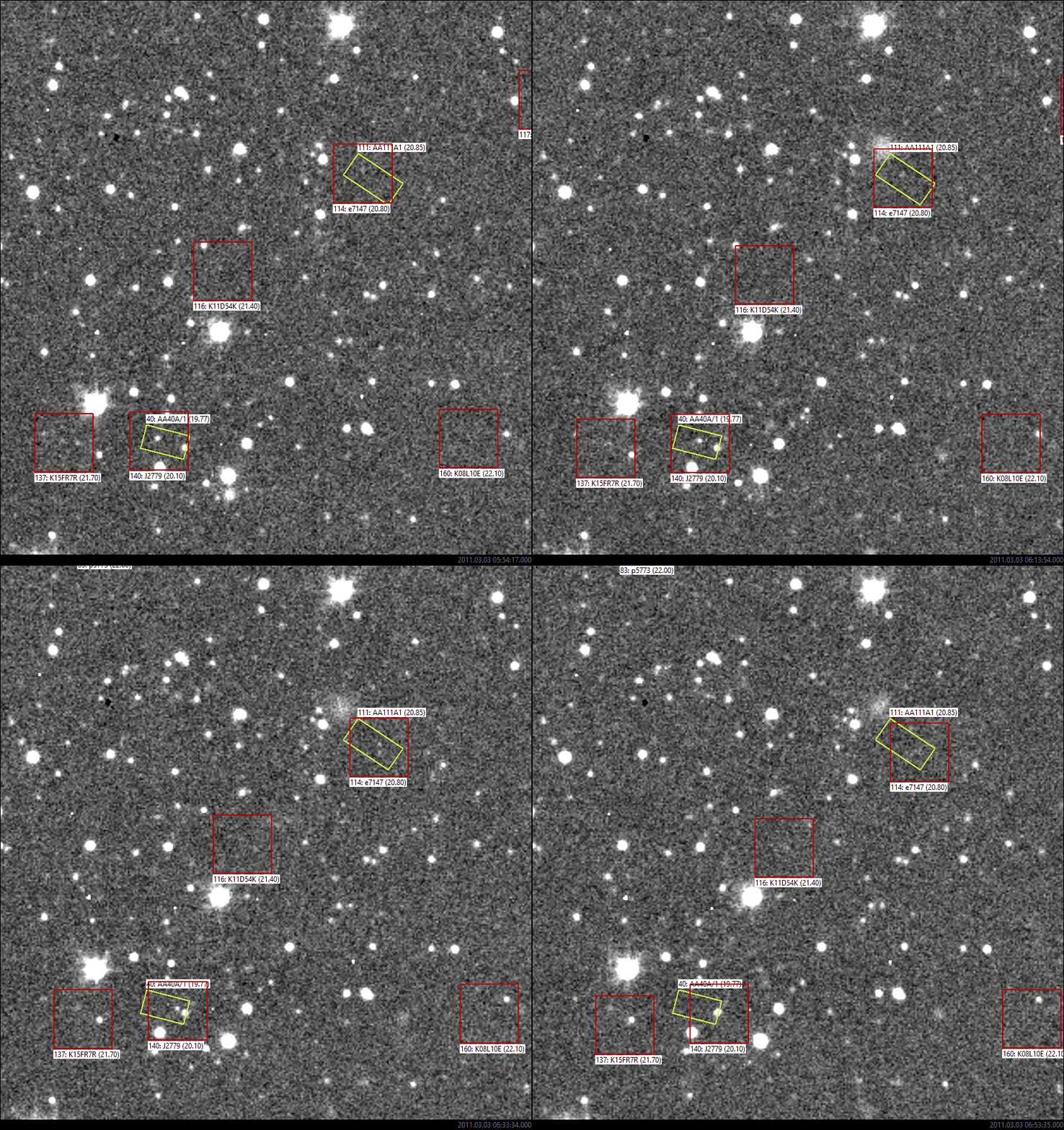
Series of four frames, which were received in the diurnal mode.
Time interval between frames is ~15 minutes.
Sky area roughly corresponds to the main-belt asteroids area.
Exposure time is 240 s. Field of view is 100х100 arc minutes.
Processed using the default settings.
Processing result:
– 137 tracks were formed;
– 92 objects were identified with MPC catalog;
– 45 false objects.
The weakest object (MPC=e7147, Lemur=AA111A1) has magnitude 20.80 with signal-to-noise ratio 3.5.
Series with raw frames:
series-as-20110303-4.zip (53 MB)
Description:
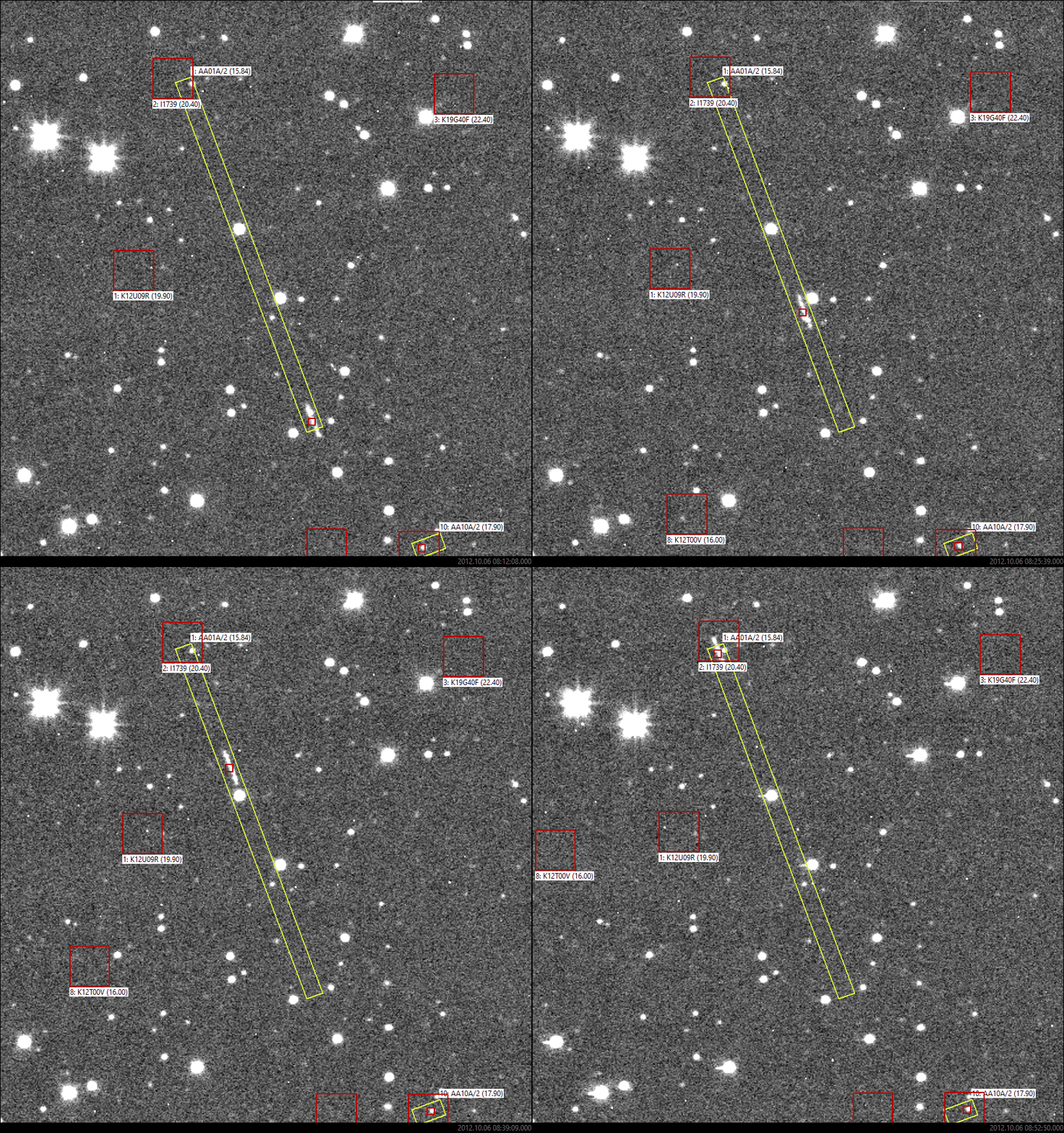
Series of four frames, which were received in the diurnal mode.
Time interval between frames is ~15 minutes.
Sky area roughly corresponds to the main-belt asteroids area.
Exposure time is 240 s. Field of view is 140х140 arc minutes.
Processed using the default settings.
Processing result:
– 62 tracks were formed;
– 45 objects were identified with MPC catalog;
– 17 false objects.
The weakest object (MPC=K02GJ3N, Lemur=AA50A42) has magnitude 20.00 with signal-to-noise ratio 3.2.
Series with raw frames:
series-as-20121006-4.zip (57 MB)
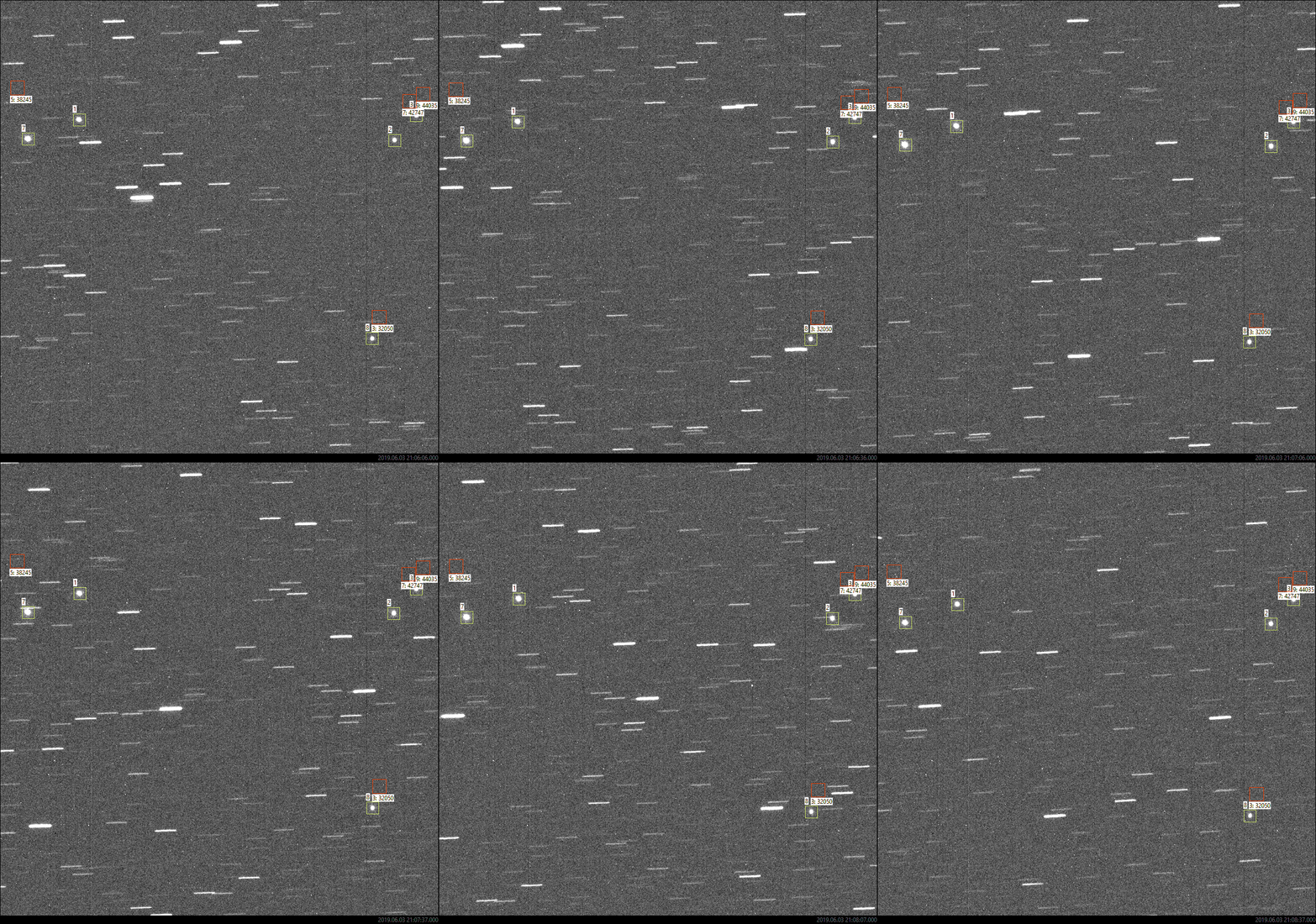
Description:
Series of 11 frames, which were received in the fixed telescope mode.
Time interval between frames is ~30 seconds.
TLE catalog was used, which made it possible to identify 7 out of 8 geostationaries, there were no TLE data for the 8th satellite.
Exposure time is 4 seconds. Field of view is 80х80 arc minutes.
Processed using the default settings with adding an orbit (TLE) for the object 32050, which made it possible to identify the detected object
Processing result:
– 8 tracks were formed.
Series in two minutes without break.
Series with raw frames:
series-sat-20190603-11-32050.zip (101 MB)
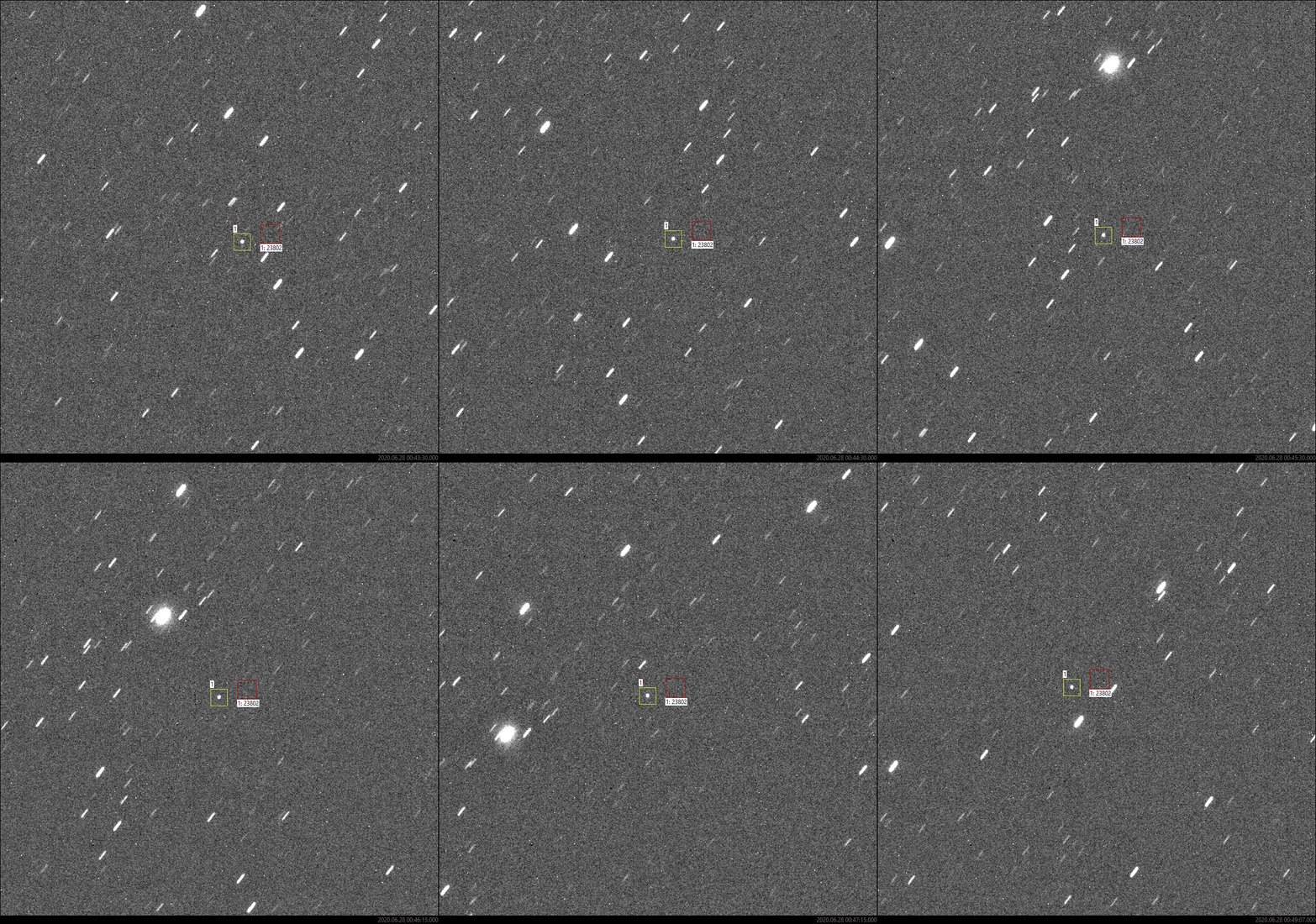
Description:
Series of 42 frames, which were received in the tracking mode for satellite 23802.
Time interval between frames is ~15 seconds.
Exposure time is 4 seconds. Field of view is 80х80 arc minutes.
Processed using the default settings with adding an orbit (TLE) for the object 23802, which made it possible to identify the detected object
Processing result:
– 1 object (23802) was formed and identified.
Series with raw frames:
series-sat-20200628-42-23802.zip (473 MB)
Papers
- Machine vision for astronomical images using the modern image processing algorithms implemented in the CoLiTec software, Measurements and Instrumentation for Machine Vision, Chapter 12: CRC Press, Taylor & Francis Group, pp. 269-310, 2020. DOI: 10.1201/9781003343783-12
- Big astronomical datasets and discovery of new celestial bodies in the Solar System in automated mode by the CoLiTec software, Knowledge Discovery in Big Data from Astronomy and Earth Observation: Astrogeoinformatics, pp. 331-345, 2020. DOI: 10.1016/B978-0-12-819154-5.00030-8
- A new method based on the subpixel Gaussian model for accurate estimation of asteroid coordinates, Monthly Notices of the Royal Astronomical Society, vol. 451 (3), pp. 3287-3298, 2015. DOI: 10.1093/mnras/stv1124
- A method of immediate detection of objects with a near-zero apparent motion in series of CCD-frames, Astronomy & Astrophysics, vol. 609 (A54), 11 p., 2018. DOI: 10.1051/0004-6361/201630323
- CoLiTecVS software for the automated reduction of photometric observations in CCD-frames, Astronomy and Computing, vol. 40 (100605), 15 p., 2022. DOI: 10.1016/j.ascom.2022.100605
- Comparative analysis of the positional accuracy of CCD measurements of small bodies in the solar system software CoLiTec and Astrometrica, Kinematics and Physics of Celestial Bodies, vol. 31 (6), pp. 302-313, 2015. DOI: 10.3103/S0884591315060045
- Selection of the reference stars for astrometric reduction of CCD-frames, Advances in Intelligent Systems and Computing, vol. 1080, pp. 881-895, 2020. DOI: 10.1007/978-3-030-33695-0_57
- CoLiTecVS – A new tool for the automated reduction of photometric observations, Astronomische Nachrichten, vol. 340 (1-3), pp. 68-70, 2023. DOI: 10.1002/asna.201913562
- Development of computational method for matched filtration with analytic profile of the blurred digital image, Eastern-European Journal of Enterprise Technologies, vol. 5 (4-119), pp. 24-32, 2022. DOI: 10.15587/1729-4061.2022.265309
- Mathematical methods for an accurate navigation of the robotic telescopes, Mathematics, vol. 11 (10), 2246, 2023. DOI: 10.3390/math11102246
- Method of maximum likelihood estimation of compact group objects location on CCD-frame, Eastern-European Journal of Enterprise Technologies, vol. 5 (4-71), pp. 16-22, 2014. DOI: 10.15587/1729-4061.2014.28028
- Development of computational method for matched filtration with analytic profile of the blurred digital image, Eastern-European Journal of Enterprise Technologies, vol. 5 (4-119), pp. 24-32, 2022. DOI: 10.15587/1729-4061.2022.265309
- Formation of a typical form of an object image in a series of digital frames, Eastern-European Journal of Enterprise Technologies, vol. 6 (2-120), pp. 51-59, 2022. DOI: 10.15587/1729-4061.2022.266988
- First reported observation of asteroids 2017 AB8, 2017 QX33, and 2017 RV12, Contributions of the Astronomical Observatory Skalnaté Pleso, vol. 53 (2), pp. 5-15, 2022. DOI: 10.31577/caosp.2023.53.2.5
- Devising a procedure for the brightness alignment of astronomical frames background by a high frequency filtration to improve accuracy of the brightness estimation of objects, Eastern-European Journal of Enterprise Technologies, vol. 2 (2-128), pp. 31-38, 2024. DOI: 10.15587/1729-4061.2024.301327
- Development of a procedure for fragmenting astronomical frames to accelerate high frequency filtering, Eastern-European Journal of Enterprise Technologies, vol. 3 (9-129), pp. 70-77, 2024. DOI: 10.15587/1729-4061.2024.306227
- CoLiTec Software for the Astronomical Data Sets Processing, IEEE International Conference on Data Stream Mining and Processing (DSMP) , 8478504, pp. 227-230, 2018. DOI: 10.1109/DSMP.2018.8478504
- Data Mining of the Astronomical Images by the CoLiTec Software, CEUR Workshop Proceedings, vol. 3171, pp. 1043-1055, 2022. http://ceur-ws.org/Vol-3171
- Astronomical knowledge discovery in databases by the CoLiTec software, Proceedings of the 12th IEEE International Conference on Advanced Computer Information Technologies, pp. 583-586, 2022. DOI: 10.1109/ACIT54803.2022.9913188
- Astronomical big data analysis by the CoLiTec software, Proceedings of the IEEE International Conference “Problems of Infocommunications. Science and Technology, pp. 391-394, 2022. DOI: 10.1109/PICST57299.2022.10238543
- Big data analysis in astronomy by the Lemur software, Proceedings of the 6th IEEE International Conference on Information and Telecommunication Technologies and Radio Electronics, pp. 5-8, 2023. DOI: 10.1109/UkrMiCo61577.2023.10380398